


Updated (November 09,2025): Brunei Stargazers See Comet Lemmon at Its Luminous Best
Comet Lemmon hit its maximum brilliance yesterday, November 8, 2025, at perihelion-its nearest point to the Sun.
At 79 million km (0.53 AU) from the Sun, Comet C/2025 A6 experienced intense solar heating that maximized the vaporization of its icy nucleus.
This sublimation process directly resulted in the comet’s most luminous coma and tail at its peak brightness, creating a truly spectacular display.
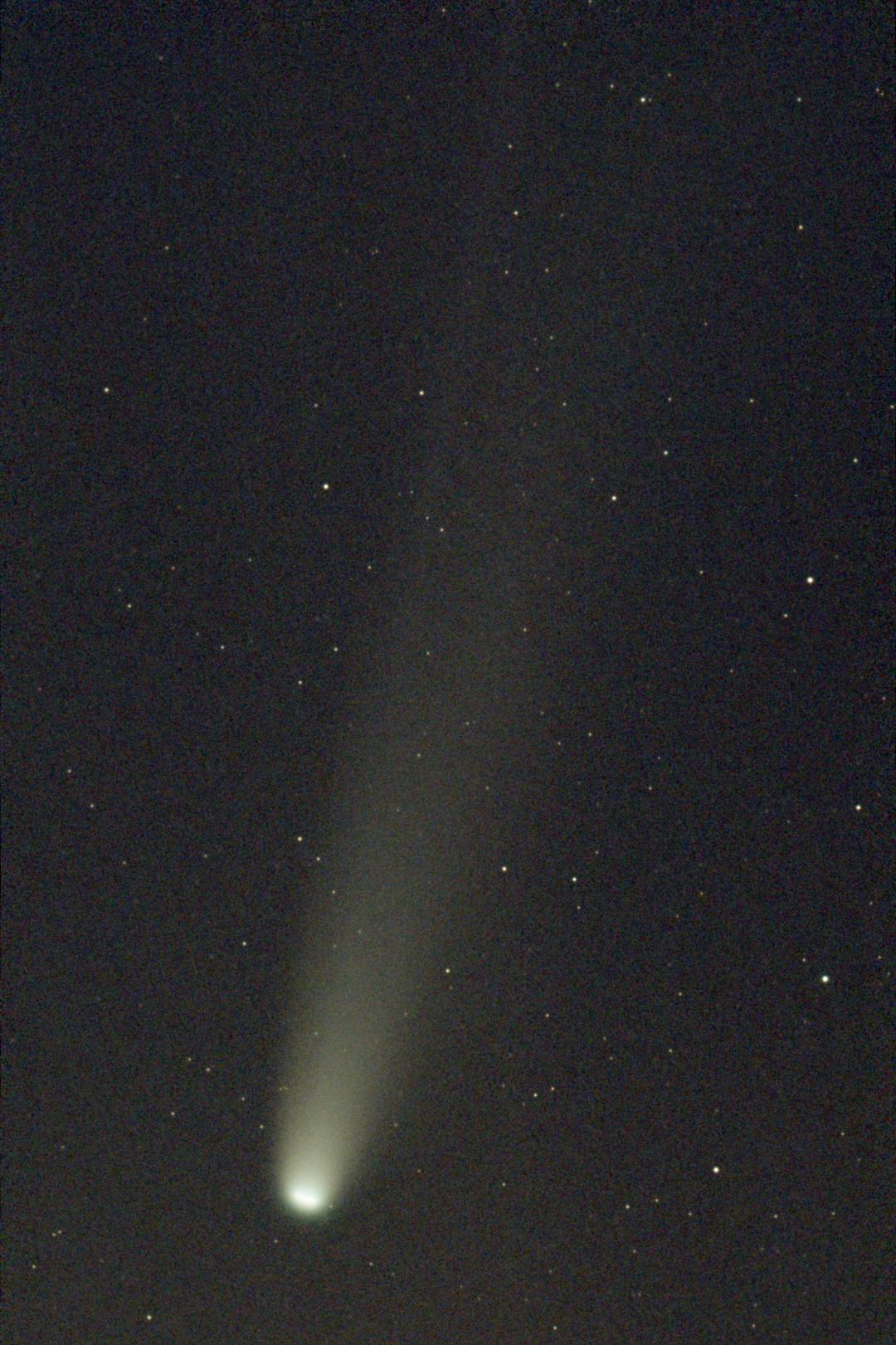
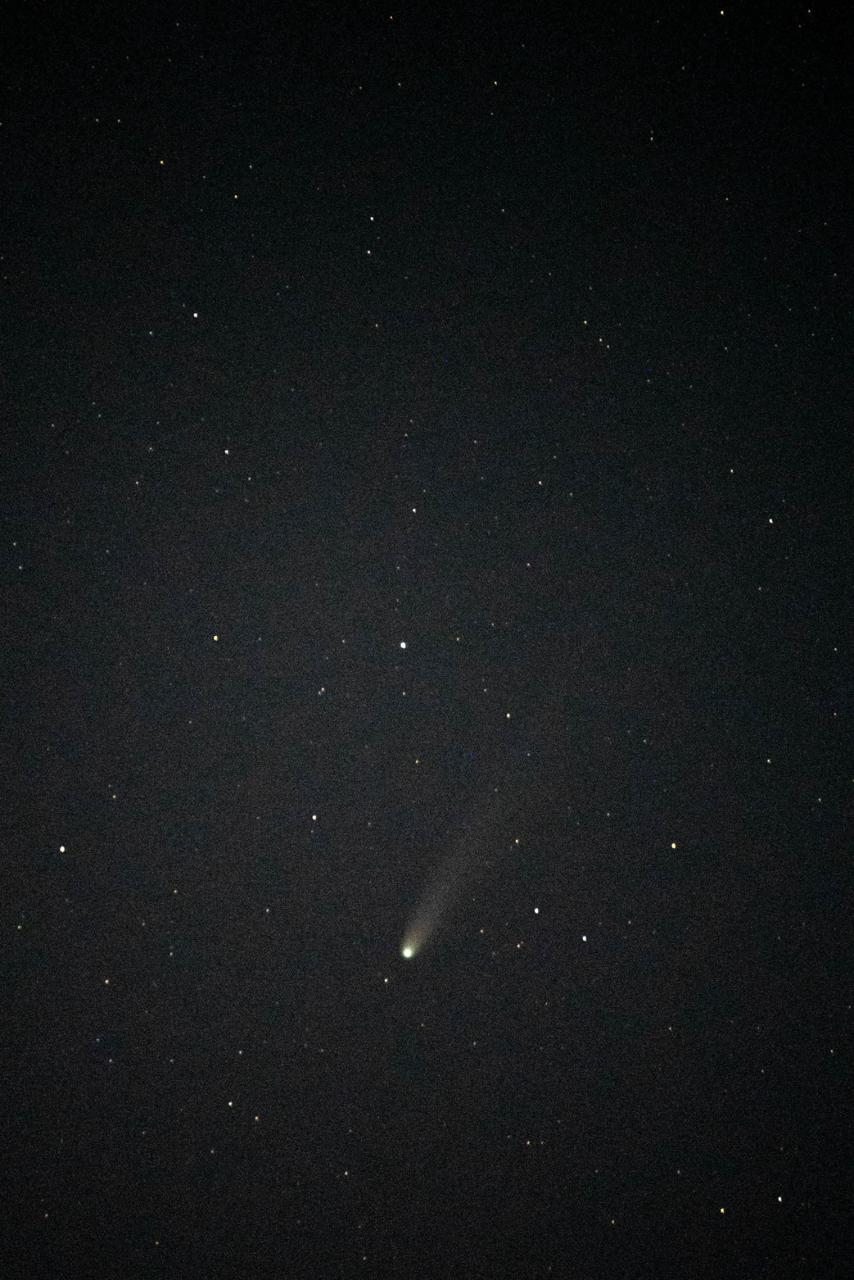
📷 Ak Muhd Adi Zulhilmi Bin Pg Yakub, the Astronomical Society of Brunei Darussalam (PABD)
🕐 November 08, 2025 at 7.00 pm
📍Tutong, Brunei Darussalam
⚙Sony FE 100-400mm f/4.5-5.6 GM

Updated (November 02, 2025): Comet C/2025 A6 Lemmon: A View from the Brunei Coast!
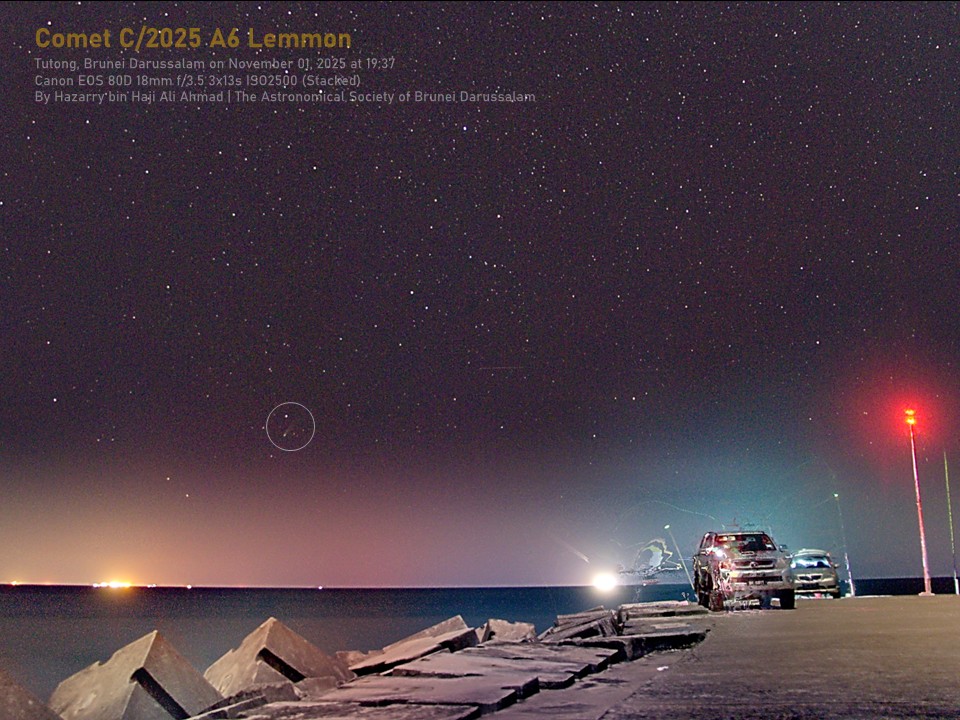
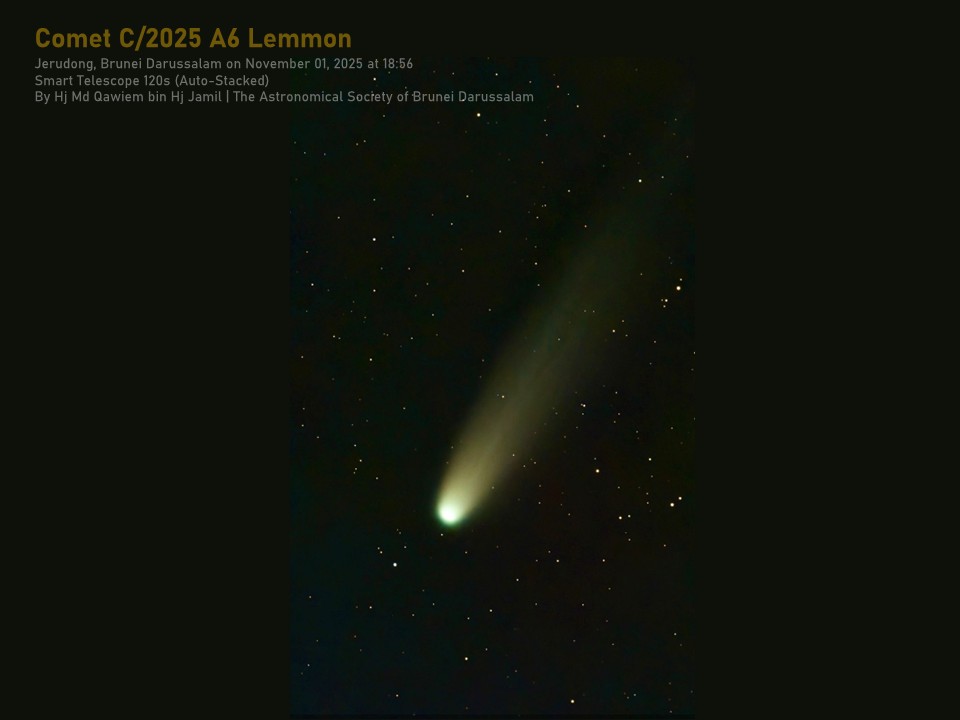
Bandar Seri Begawan – What an amazing sight! Local stargazers of The Astronomical Society of Brunei Darussalam (PABD) managed to capture a truly spectacular, once-in-a-lifetime photo yesterday evening, on November 01, 2025.
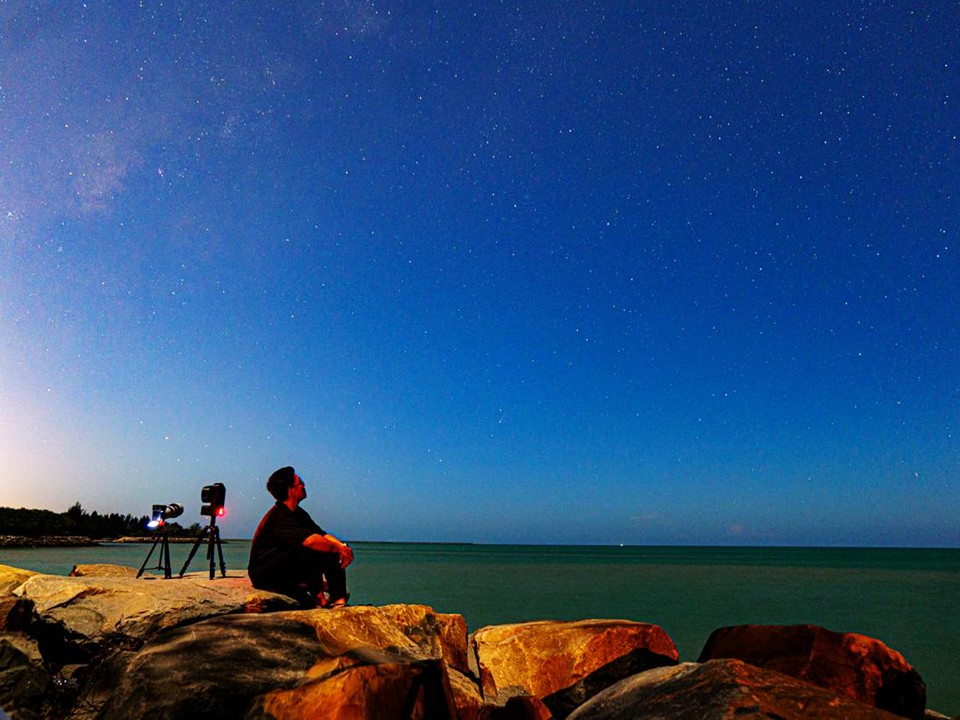
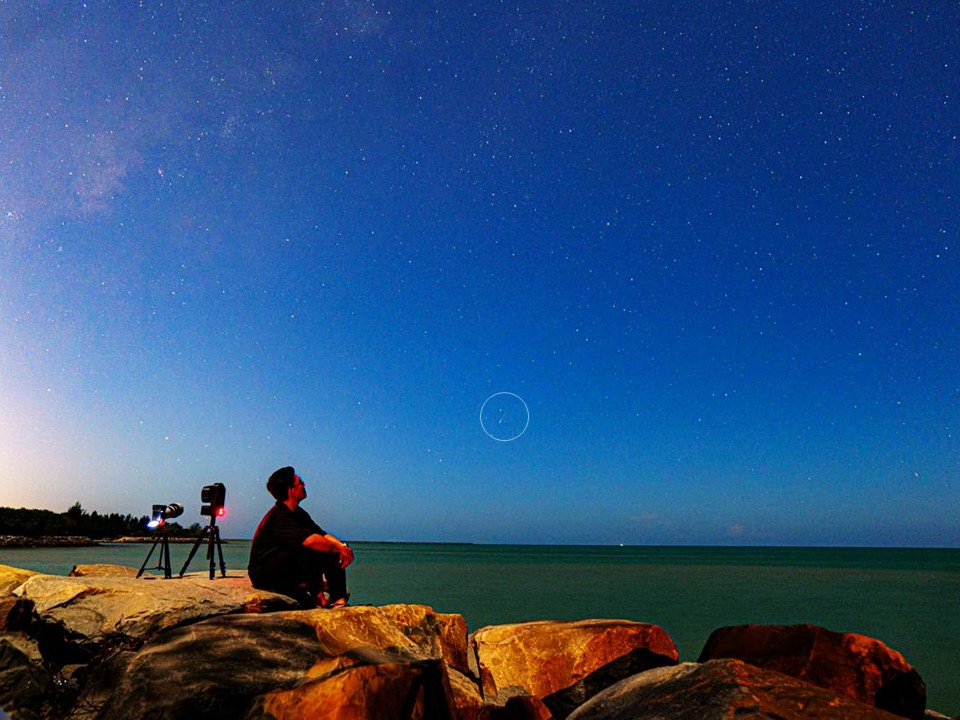
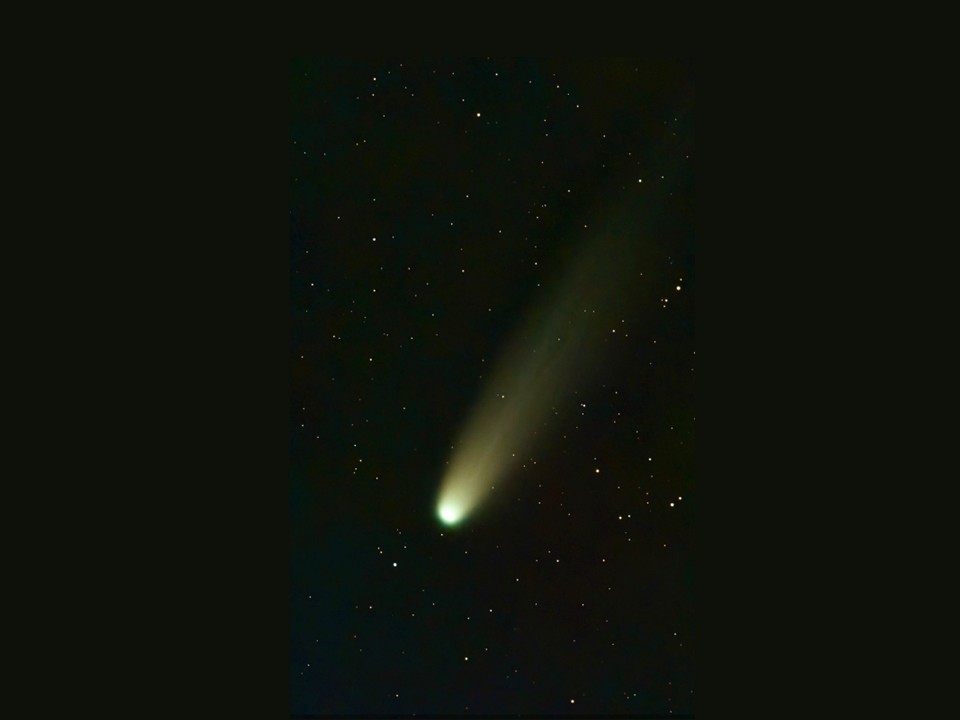
These images frame Comet C/2025 A6 Lemmon low over the South China Sea. The coastline’s clear western horizon provided the perfect, unobstructed view needed to catch this long-period comet, which only visits our inner solar system once every 1,150 to 1,350 years.
It unexpectedly brightened this season, allowing it to be easily seen with binoculars and even photographed. Don’t forget to look up and try to spot this amazing visitor while you can!

Updated (October 25, 2025): Bright Comet Lemmon Visible from Brunei Twilight

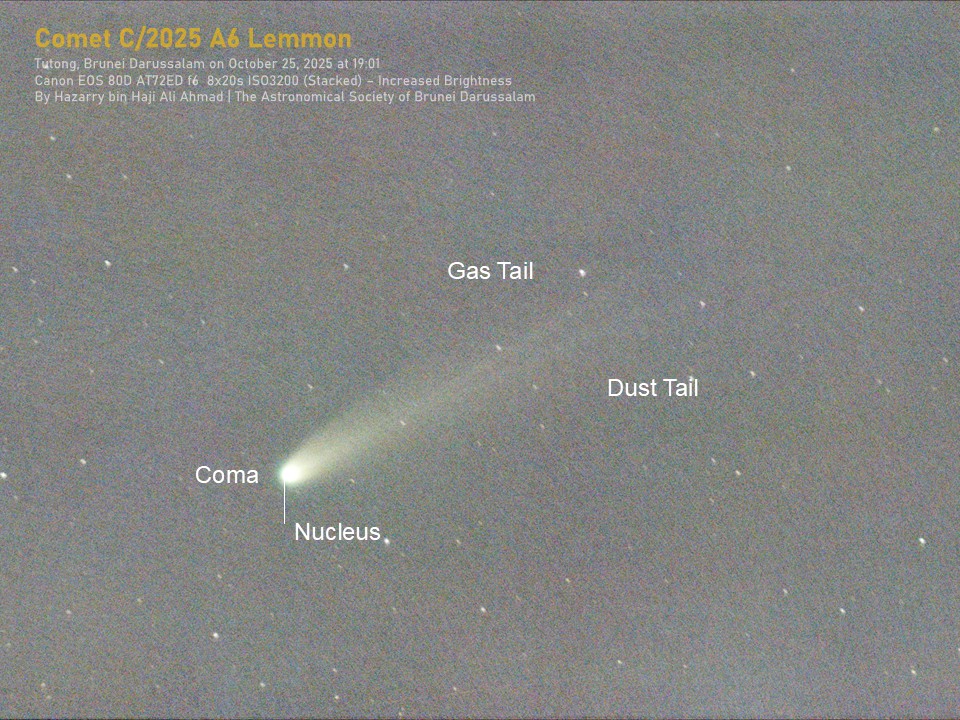
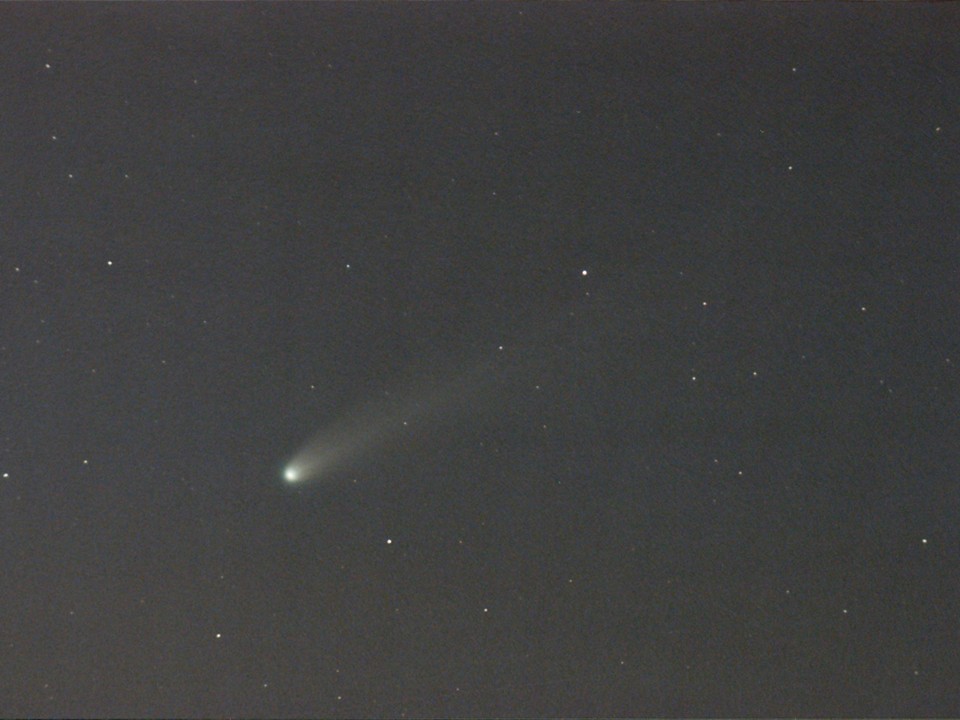
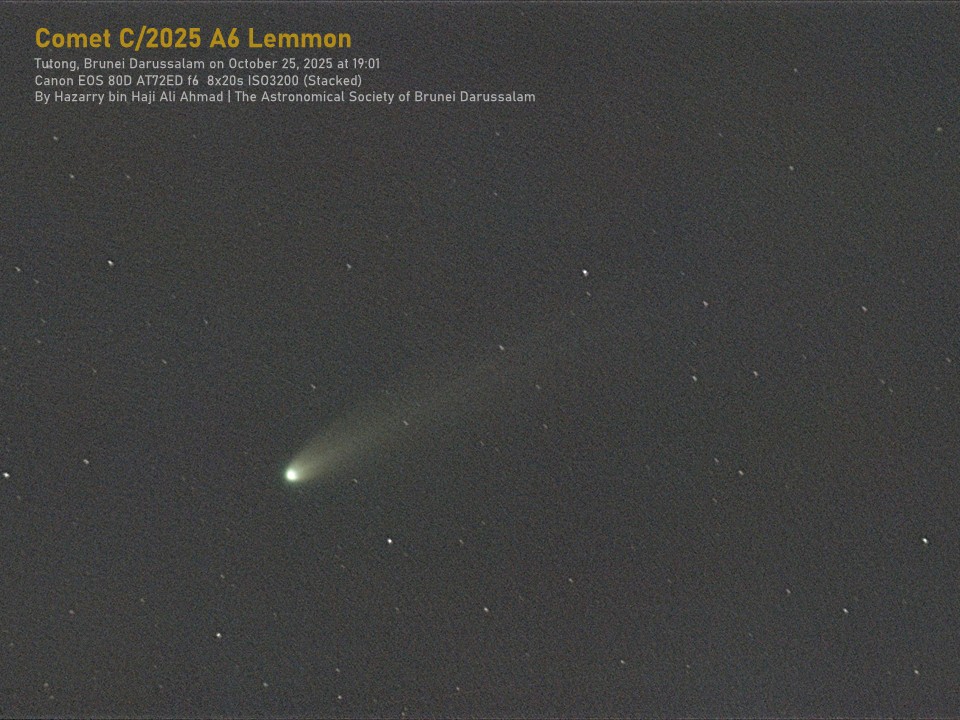
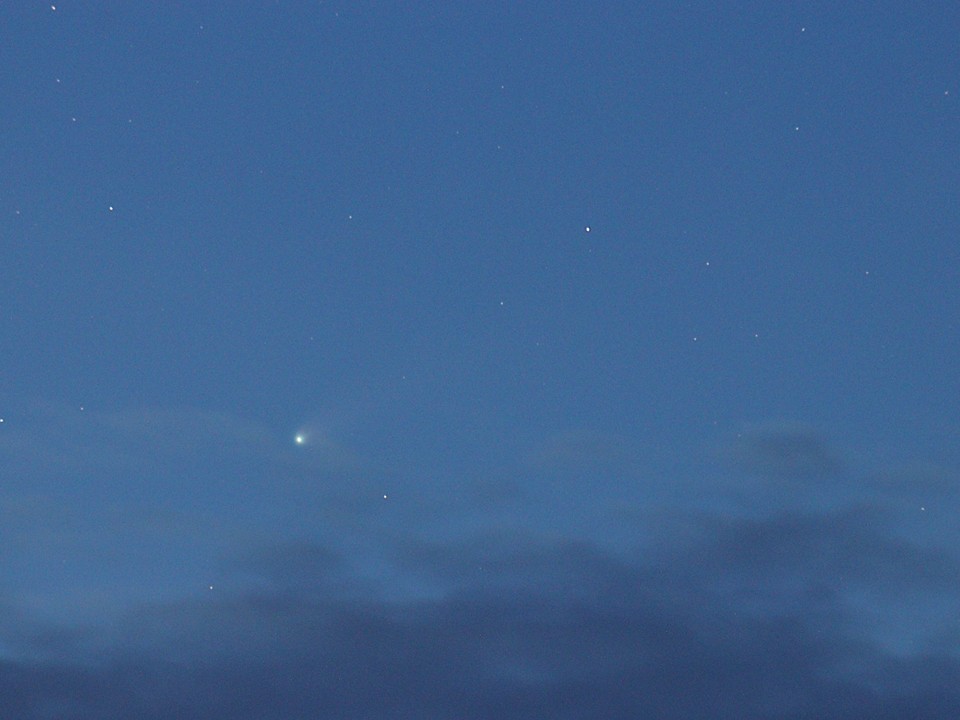
Tutong – On the evening of October 25, 2025, Comet C/2025 A6 Lemmon was successfully observed from Brunei Darussalam, despite intermittent cloud cover and lingering twilight. The comet appeared sufficiently luminous to be photographed even before the onset of full astronomical darkness, demonstrating its exceptional brightness and prominence in the northwestern sky.
The comet’s distinct greenish hue and extended tail were discernible above the horizon, offering a rare opportunity for local stargazers and astrophotographers. Its visibility under such conditions underscores the comet’s current magnitude and favourable positioning for Northern Hemisphere viewing.

Members of the public in Brunei Darussalam are encouraged to continue observing Comet Lemmon over the coming days as it is approaching close to the Sun. Comet can surprise observers with unpredictable brightening events, or outbursts, as they approach the Sun due to rapid sublimation of ices, structural changes in their nucleus, and variable dust release.
From Brunei Darussalam, optimal viewing occurs approximately 45 to 60 minutes after sunset, with the comet located low in the northwest horizon. Binoculars or small telescopes are recommended to enhance visibility, especially in areas affected by light pollution or partial cloud cover. (Read previous post below for more observing tips)
A comet is a small celestial body composed primarily of ice, dust, and rocky material that orbits the Sun. This ancient remnants from the early solar system develops a glowing coma and tail when heated, often visible from Earth as it passes through the inner solar system.
First Posted on: October 22, 2025
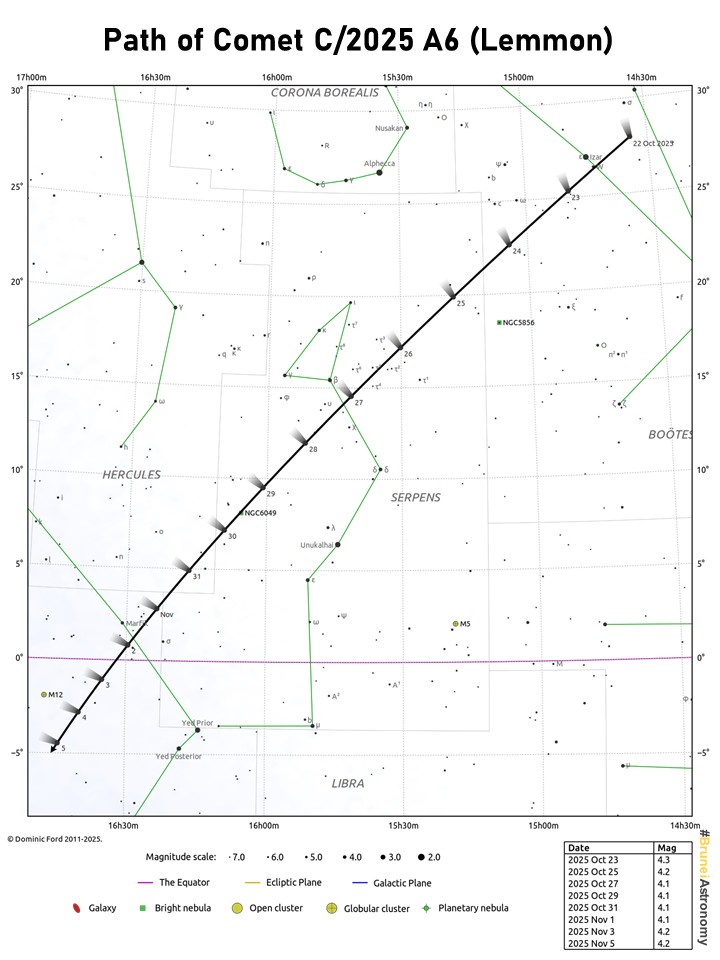
Bandar Seri Begawan – Comet C/2025 A6 (Lemmon) has brightened to magnitude 3.9 (COBS), making it a stunning naked-eye visitor under pristine dark skies. Now drifting through the constellation Bootes and heading toward Ophiuchus, Lemmon passed closest to Earth on Oct 21 at a distance of 89.08 million km.
Starting this evening, Oct 22, until mid-Nov, Brunei skywatchers can catch this cosmic wanderer shortly after sunset. Look west from a location far from city lights with a clear horizon – Lemmon will appear as a faint, fuzzy glow with a tail stretching several degrees across the twilight sky. A small telescope or binoculars will enhance the view, but no equipment is needed if skies are dark and clear.
Use a compass to locate the western horizon. Then, refer to the Ephemeris table below to determine the approximate azimuth angle of the comet’s setting position as seen from Brunei Darussalam. The comet should appear very close to the horizon. Comet hunters in Brunei can also use a free online star chart (https://bruneiastronomy.org/starchart) to find out if the Lemmon is visible in the sky.
Astrophotographers, take note: Lemmon is forecast to peak around magnitude 4 in early Nov, likely becoming the brightest comet of 2025. Its long tail and evolving coma offer a rare opportunity to capture dynamic cometary features.
Discovered by the Mount Lemmon Survey on January 3, 2025, at a dim magnitude 21.5, it was initially mistaken for an asteroid. Precovery images from Pan-STARRS (Nov 2024) and follow-up observations confirmed its cometary nature, revealing a condensed coma and a short tail.
Last chance for a millennium: Comet Lemmon won’t return for over a thousand years. This is a once-in-a-lifetime opportunity to witness a visitor from the outer reaches of our solar system.
Table: Ephemeris for C/2025 A6 (Lemmon) from Brunei Darussalam
| Date | RA | DEC | Set | Set Azimuth | ~Mag. (JPL) | Earth Dist (AU) | Sun Dist (AU) | Constellation |
| Wed, Oct 22, 2025 | 14h49m | +25°19′ | 19:12 | 297 (WNW) | 5.3 | 0.603 | 0.653 | Bootes |
| Thu, Oct 23, 2025 | 15h04m | +22°37’ | 19:22 | 294 (WNW) | 5.3 | 0.611 | 0.641 | Bootes |
| Fri, Oct 24, 2025 | 15h17m | +19°54′ | 19:31 | 291 (WNW) | 5.2 | 0.623 | 0.628 | Serpens Caput |
| Sat, Oct 25, 2025 | 15h30m | +17°11′ | 19:38 | 288 (WNW) | 5.2 | 0.638 | 0.616 | Serpens Caput |
| Sun, Oct 26, 2025 | 15h41m | +14°32′ | 19:45 | 286 (WNW) | 5.1 | 0.655 | 0.605 | Serpens Caput |
| Mon, Oct 27, 2025 | 15h51m | +11°57′ | 19:51 | 283 (WNW) | 5.1 | 0.676 | 0.594 | Serpens Caput |
| Tue, Oct 28, 2025 | 16h00m | +09°29′ | 19:56 | 281 (W) | 5.1 | 0.698 | 0.584 | Serpens Caput |
| Wed, Oct 29, 2025 | 16h09m | +07°07′ | 20:00 | 278 (W) | 5 | 0.723 | 0.575 | Serpens Caput |
| Thu, Oct 30, 2025 | 16h16m | +04°53′ | 20:03 | 276 (W) | 5 | 0.750 | 0.566 | Hercules |
| Fri, Oct 31, 2025 | 16h23m | +02°47′ | 20:05 | 274 (W) | 4.9 | 0.779 | 0.559 | Ophiuchus |
| Sat, Nov 1, 2025 | 16h29m | +00°47′ | 20:07 | 272 (W) | 4.9 | 0.809 | 0.552 | Ophiuchus |
| Sun, Nov 2, 2025 | 16h35m | −01°04′ | 20:08 | 270 (W) | 4.9 | 0.840 | 0.546 | Ophiuchus |
| Mon, Nov 3, 2025 | 16h39m | −02°49′ | 20:08 | 268 (W) | 4.9 | 0.872 | 0.541 | Ophiuchus |
| Tue, Nov 4, 2025 | 16h44m | −04°28′ | 20:08 | 266 (W) | 4.9 | 0.905 | 0.536 | Ophiuchus |
| Wed, Nov 5, 2025 | 16h48m | −06°02′ | 20:08 | 265 (W) | 4.9 | 0.938 | 0.533 | Ophiuchus |
| Thu, Nov 6, 2025 | 16h51m | −07°29′ | 20:07 | 263 (W) | 4.9 | 0.972 | 0.531 | Ophiuchus |
| Fri, Nov 7, 2025 | 16h54m | −08°52′ | 20:06 | 262 (W) | 4.9 | 1.006 | 0.530 | Ophiuchus |
| Sat, Nov 8, 2025 | 16h57m | −10°10′ | 20:04 | 260 (W) | 4.9 | 1.041 | 0.530 | Ophiuchus |
| Sun, Nov 9, 2025 | 16h59m | −11°24′ | 20:02 | 259 (W) | 5 | 1.075 | 0.531 | Ophiuchus |
| Mon, Nov 10, 2025 | 17h01m | −12°33′ | 20:00 | 258 (WSW) | 5 | 1.109 | 0.533 | Ophiuchus |
| Tue, Nov 11, 2025 | 17h03m | −13°39′ | 19:57 | 257 (WSW) | 5.1 | 1.144 | 0.536 | Ophiuchus |
| Wed, Nov 12, 2025 | 17h04m | −14°42′ | 19:55 | 256 (WSW) | 5.1 | 1.177 | 0.540 | Ophiuchus |
More Update Soon….