


By Hazarry bin Haji Ali Ahmad
SUMMARY
● Early Viewing Recommended: The Perseid meteor shower peaks around August 12–13, 2025, but a bright full Moon will hinder visibility. Observers are encouraged to watch between July 29 and August 5, when moonlight is minimal and skies are darker.
● Meteor Origins and Activity: The Perseids result from Earth passing through debris from Comet Swift–Tuttle. Meteors can reach rates of 50–75 per hour under ideal conditions, though moonlight may reduce this by up to 75%.
● Optimal Viewing Tips: Best viewing is after midnight in rural or elevated areas with clear horizons. Allow 20–30 minutes for eyes to adjust. No telescopes needed!
Bandar Seri Begawan – Every August, the Perseid meteor shower graces the night skies in Brunei Darussalam with swift streaks of cosmic light. But in 2025, nature throws in an extra twist – you’ll want to plan around.
Although the Perseids peak around August 12–13, this year’s show clashes with a bright full Moon. Its glow is expected to significantly diminish visibility due to its intense brightness. Enthusiasts are encouraged to seize this pre-peak window to fully appreciate the brilliance and wonder of the Perseid meteor shower before lunar conditions become prohibitive.
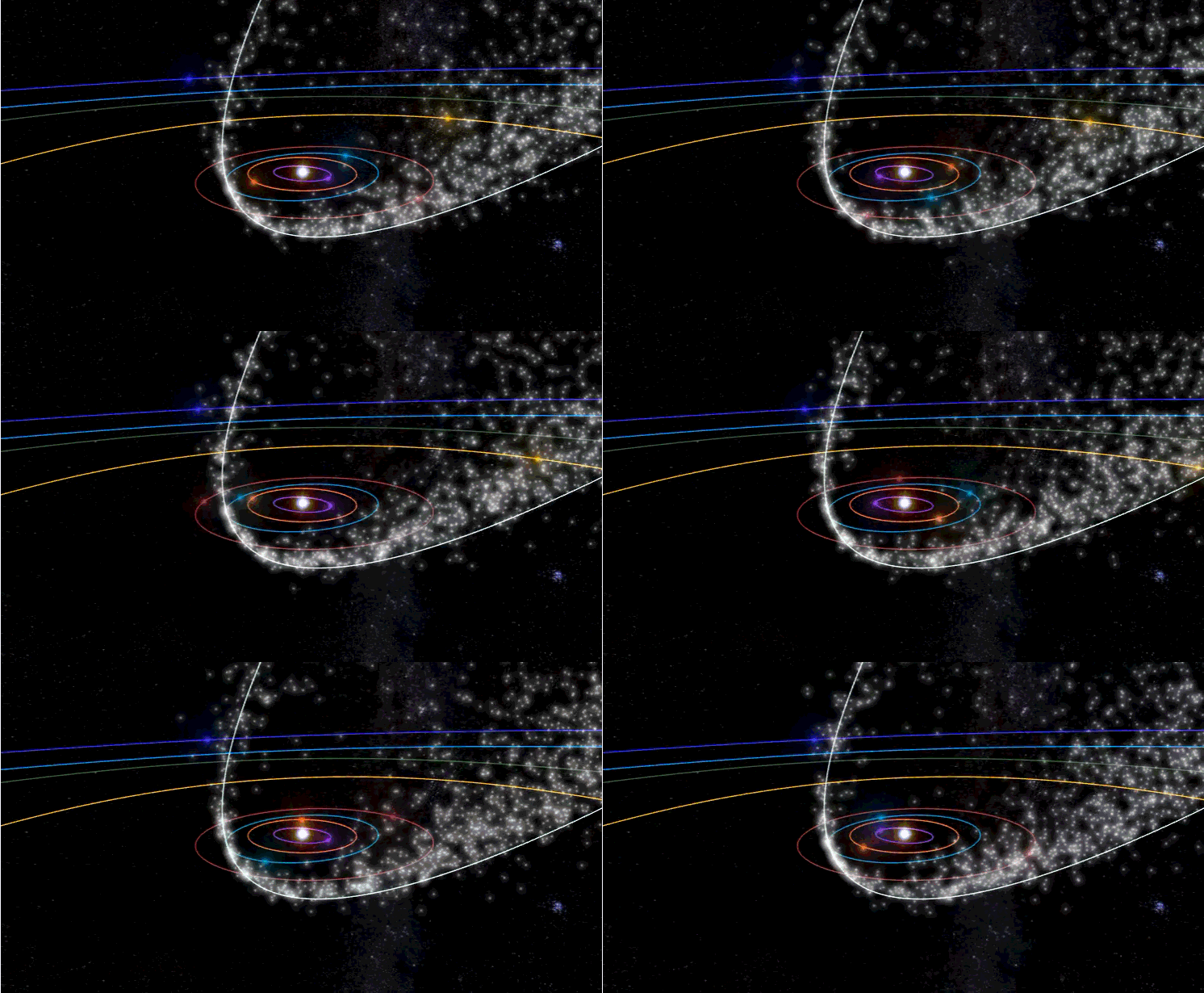
▲ Perseids meteor shower peaks in mid-August, when Earth intersects the dust cloud left by comet Swift-Tuttle (Illustration: IMO)
The Perseids are active from July 14 to September 1. They occur as Earth intersects the orbital path of 109P/Comet Swift–Tuttle, whose debris trail comprises minute fragments of ice and rock. As these particles enter Earth’s atmosphere at high velocities, they disintegrate, producing luminous streaks known as meteors. According to the International Meteor Organization (IMO), normal rates of Perseids seen from rural locations are ranging from 50-75 showers per hour at maximum. But because of the presence of the Full Moon, the resultant sky brightness is expected to diminish meteor counts by up to 75 percent, limiting observation primarily to the brightest meteors.

▲ A bright Perseid meteor during Meteor Shower Camp in Tutong, Brunei Darussalam, on August 10, 2019 (Photo by PABD)
The radiant, or apparent point of origin, lies in the constellation Perseus, from which the meteor shower derives its name. Online star charts by BruneiAstronomy is available here to determine the location in the night sky of Perseus, which means Bearer of the Demon’s Head, from Brunei.
To optimize the viewing experience, it is strongly recommended that observers plan their stargazing sessions during the nights preceding the peak. This year, watch in the days before the peak on around end of July through first week of August (from July 29 until August 5), when moonlight is minimal and meteors zip through darker skies. The Moon will be less dominant in the early predawn sky during these dates, allowing darker conditions conducive to meteor visibility.
Hence, observers may witness a greater number of meteors unobscured by lunar glare. Refer to this schedule for detailed information on the moon’s rise and set times, along with its current illumination phase. A higher illumination value indicates a brighter moon, which contributes to greater sky glow – potentially reducing visibility of fainter meteors.
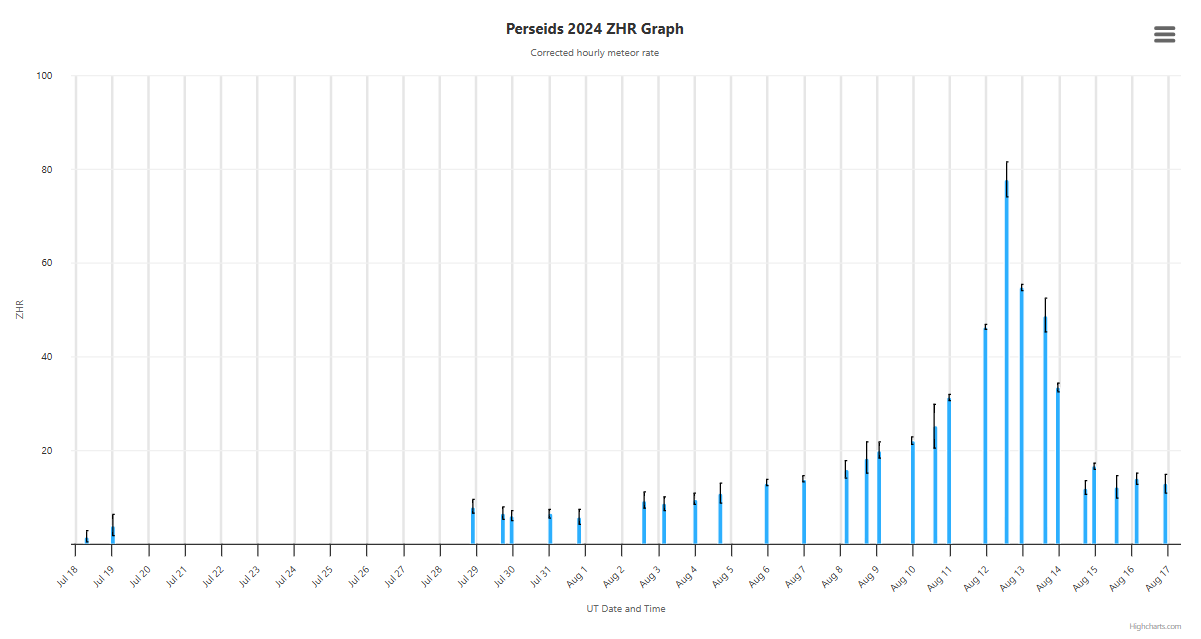
▲ 2024 ZHR Perseids meteor chart which shows the number of meteors an observer would see under a very dark sky in July and August (by IMO)
For meteor shower watch, observations are most favorable after midnight until dawn, when the radiant ascends higher in the northeastern sky. It is best to select a site distant from artificial lighting, such as rural or elevated locations with unobstructed views of the horizon. When arrive at your stargazing spot, allocate 20 to 30 minutes for eyes to acclimate to the darkness, and make sure to equip yourself with comfortable seating, suitable attire, and necessary provisions such as mosquito repellent etc.
Although the full Moon presents a challenge during the Perseid peak, early viewing offers an exceptional opportunity to witness one of nature’s most remarkable spectacles. These meteors, remnants of a comet last recorded approach in 1992, underscore Earth’s continual interaction with our dynamic solar system.