


Bandar Seri Begawan – Automated sky monitoring cameras operated by the Astronomical Society of Brunei Darussalam (PABD) in Tutong, captured a lively display from the annual Leonid meteor shower early this morning, November 19, 2026.
Despite the shower having passed its nominal annual peak on November 17, the SkyCam and Meteor Station recorded more than 30 bright Leonids including several brilliant fireballs streaking across the pre-dawn skies above Brunei Darussalam.

Originating from debris shed by Comet 55P/Tempel–Tuttle, Leonid meteoroids strike Earth’s atmosphere head-on at roughly 71 kilometers per second, making them the fastest of all annual meteor showers. Because of this extreme velocity, even millimeter- to centimeter-sized particles vaporize intensely, producing vivid streaks, persistent glowing ionized trails, and occasional fireballs brighter than magnitude -3.
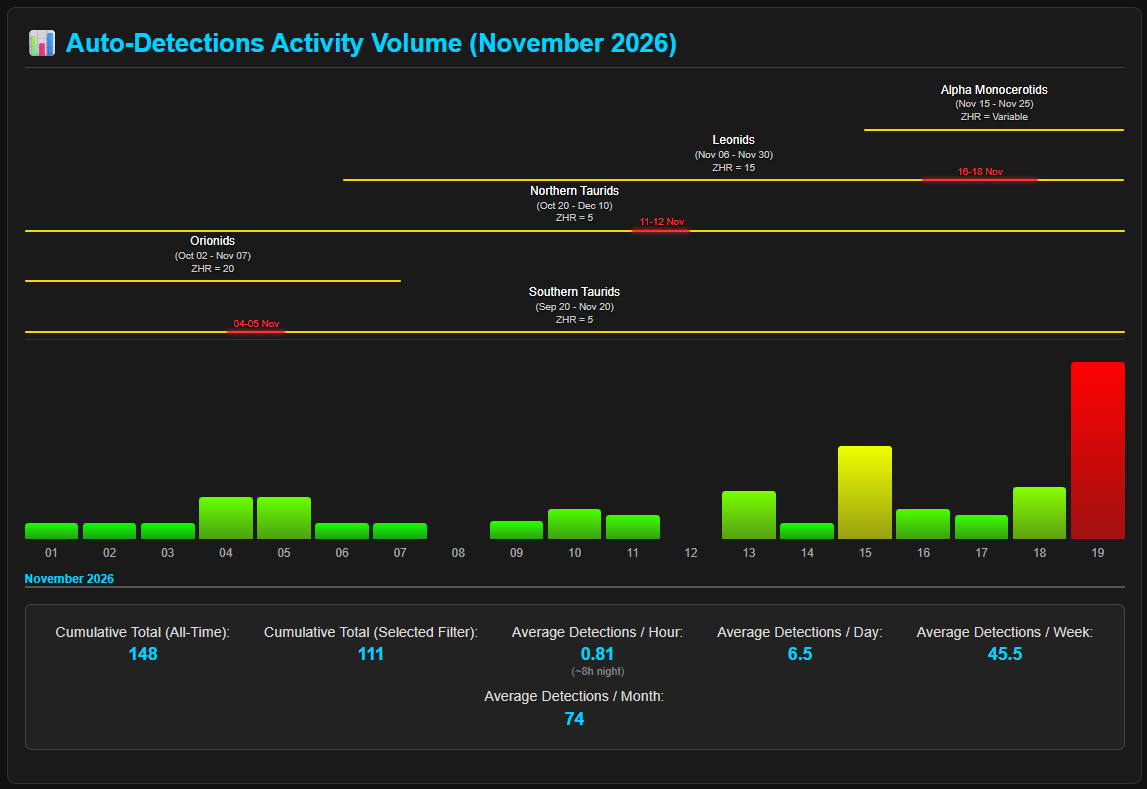
While typical years, like this year, yield only 10–15 meteors per hour, the Leonids are famous for erupting every 33 years into true meteor storms (exceeding 1,000 per hour), led by the historic 1966 storm that peaked at an astonishing 144,000 meteors per hour (thousands per minute), whereas the last true storm occurred in 2002 at 2,000 to 3,000 meteors per hour (2021 was a quiet baseline year washed out by a bright Moon). Looking ahead, astronomers predict strong outbursts of 35–500 meteors per hour in 2033 and 2034 following Comet Tempel–Tuttle’s 2031 return, though orbital modeling indicates Jupiter’s gravity will deflect the densest dust filaments and delay the next full-scale storm until 2099.
